Best Online Casino Game Shows UK: What to Know
 Available in GB
Understand the formats, presentation and pace behind live casino game shows, from studio atmosphere to the mechanics of each round.
What Are Casino Game Shows, and Why Do They Feel Different?
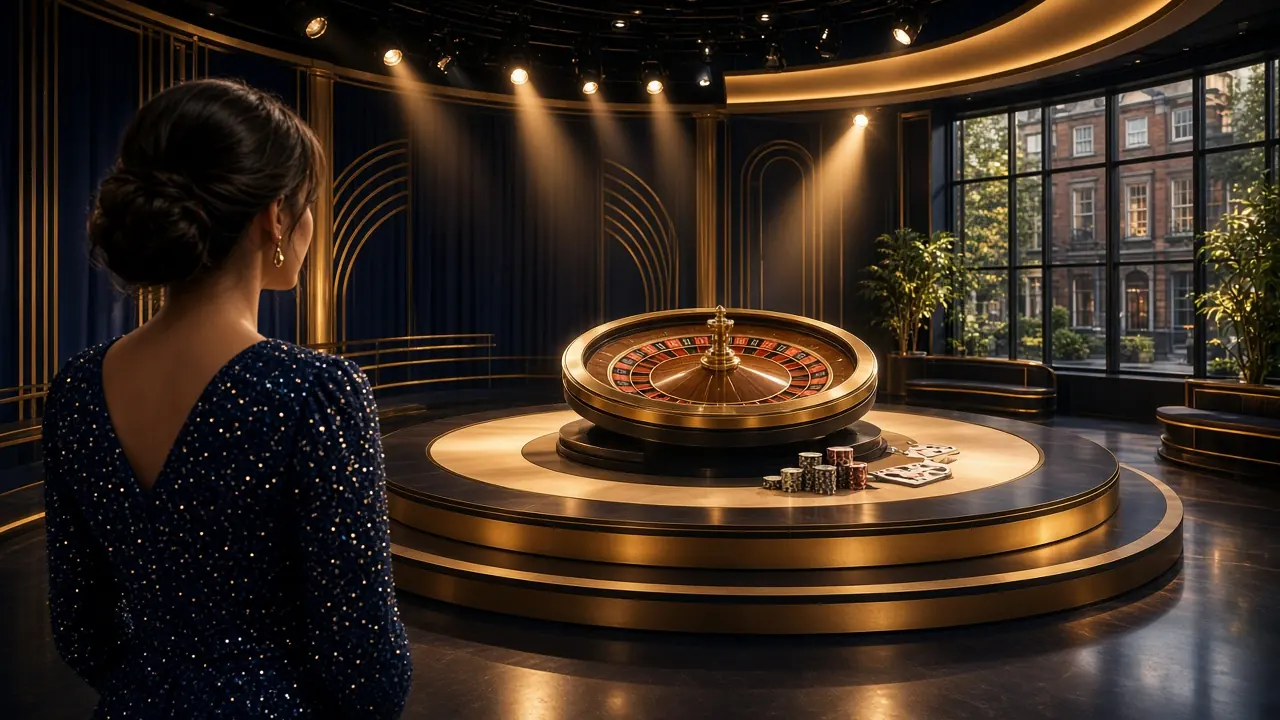
Casino game shows sit between a television programme and a conventional online table game. There is a presenter, a studio, a visible set, music, lighting and a sequence of rounds that gives the session a beginning, middle and end. Yet beneath the theatrical surface remains a casino product: stakes are placed through an online interface, outcomes are governed by the rules of the particular game, and money changes hands according to those rules.
That mixture explains the category’s peculiar appeal. A standard roulette table can feel like a machine for repeated decisions. A live game show adds a small social drama around each result. The wheel turns in a studio rather than in an abstract animation. A presenter announces the round rather than leaving the screen silent. The interval between placing a stake and seeing the outcome becomes part of the entertainment instead of merely a pause.
The best online casino game shows in the UK are therefore not simply the games with the loudest graphics. They are formats in which presentation, pace and casino mechanics hold together. If the studio feels detached from the rules, the spectacle becomes decoration. If the rules overwhelm the presentation, the programme-like quality disappears. The format works when both sides remain visible.
This page highlights key facts to help you assess online casino game show options in the UK for 2026. Use the listed licensing, bonus, payout speed and deposit details as a starting point when choosing a suitable operator.
License: UKGC Operator Licence · Bonus: £20 bonus · Payout speed: Within 48 hours · Min. deposit: £10 Silverbond Enterprises holds a UKGC Operator Licence and offers a £20 bonus. Its minimum deposit is £10, with payouts stated as being available within 48 hours.
License: UKGC Operator Licence · Bonus: £200 welcome bonus · Payout speed: Within 48 hours · Min. deposit: £10 32Red is listed with a UKGC Operator Licence and a £200 welcome bonus. It has a £10 minimum deposit, while payouts are stated as being available within 48 hours.
License: UKGC Operator Licence · Bonus: £100 bonus · Payout speed: Within 24 hours · Min. deposit: £10 Genesis Global Limited holds a UKGC Operator Licence and offers a £100 bonus. The minimum deposit is £10, with payouts stated as being available within 24 hours.
License: UKGC Operator Licence · Bonus: £100 bonus · Payout speed: Within 24 hours · Min. deposit: £10 LeoVegas is listed with a UKGC Operator Licence and a £100 bonus. It accepts a minimum deposit of £10, with payouts stated as being available within 24 hours.
License: UKGC Operator Licence · Bonus: £50 bonus · Payout speed: Within 48 hours · Min. deposit: £10 Platinum Gaming Limited holds a UKGC Operator Licence and offers a £50 bonus. Its minimum deposit is £10, and payouts are stated as being available within 48 hours.
License: UKGC Operator Licence · Bonus: £100 bonus · Payout speed: Within 24 hours · Min. deposit: £10 ProgressPlay Limited is listed with a UKGC Operator Licence and a £100 bonus. It has a £10 minimum deposit, with payouts stated as being available within 24 hours.
A casino game with a television grammar
The phrase “game show” carries a cultural memory older than online gambling. Television made contests legible through a host, a set, a countdown, a prize structure and a repeated ritual. The audience learns where to look and when something matters. Live casino game shows borrow that grammar without becoming television in the full sense. There is no broad studio audience deciding the result, and the participant’s stake does not turn the event into a general-knowledge contest. The casino mechanism remains in charge.
A presenter may introduce the round, invite the wheel to spin, explain a bonus feature or react to a result. The language is often more animated than the language of a traditional table, but the essential function is practical: the presenter keeps the sequence understandable. In a format built around recurring rounds, that matters. The host is not merely a decorative face placed beside a random event. The host supplies continuity.
This is why online casino live game shows can feel more immediate than an ordinary automated game. The screen shows a person performing the action and acknowledging the result. Even when the player is not making a decision at every stage, the presence of another human being gives the sequence a social outline. The experience resembles watching a compact broadcast in which the viewer also has a financial interest.
That resemblance should not be confused with control. A presenter can guide the round, but cannot make a result favourable. The set may be elaborate; the outcome still follows the game’s rules. The camera may linger on a wheel or a prize display; the visual emphasis does not alter the underlying mathematics.
How the live element changes the experience
“Live” refers to the production environment and the dealing or presenting of the round, not to a promise that the player can influence the result. A live casino game show online transmits a studio event to the player’s device. The software handles the account, the wager and the settlement, while the studio supplies the visible performance.
That division is easy to miss because the two systems appear on one screen. The presenter, graphics and physical equipment belong to the broadcast layer. The betting interface belongs to the casino layer. A player may select a stake, watch the round and receive a result without ever seeing where one technical system ends and the other begins.
The distinction is useful because it separates atmosphere from function:
- Studio production provides the presenter, set, cameras, lighting, sound and visible equipment.
- Game software defines the available actions, rules, result structure and payout information.
- Casino platform provides the account interface through which a player accesses the game.
- Regulated operation governs how the game is offered to people in Great Britain.
A live game show casino experience depends on all four layers. A polished studio cannot compensate for unclear rules. A well-designed interface cannot turn a poorly presented round into compelling television. A familiar format still has to be offered within the UK regulatory framework.
What makes these formats different from live roulette
Live roulette is already a social and visual form of online gambling, but its structure is comparatively spare. The wheel, the table layout and the dealer provide the drama. Casino game shows often add a more explicit programme format: a host-led sequence, themed stages, bonus rounds or changing visual cues.
The difference is not that one is random and the other is not. Both depend on the rules of the relevant game. The difference lies in how the result is framed. Roulette presents a recognised table ritual. A game show presents a series of events arranged for viewing. There may be suspense before a particular segment, a change in music when a special round appears, or a presenter’s explanation of what happens next.
This makes the category easier to watch in short sessions. A player does not need to construct all the atmosphere internally; the production does some of the work. The studio marks transitions. The host gives the round a rhythm. The game’s visual identity tells the viewer whether an ordinary phase or a special feature is taking place.
Market United Kingdom
Language English
Focus Online Casino Game Shows
The same qualities can also make the experience more distracting. Spectacle encourages attention to the next moment rather than to the accumulated result of earlier play. A dramatic reveal is still a reveal of a rule-governed outcome, not evidence that the next round is becoming more favourable. Theatrical pacing is not probability.
That small sentence deserves its own chair.
Presenter-led rounds and the feeling of participation
The presenter changes the emotional texture of casino game shows because a human voice turns a repeated procedure into an occasion. A wheel spin can be described in functional terms: choose an option, place a stake, await the outcome. In a studio format, the same procedure is announced, performed and acknowledged. The player is given a role in a shared sequence, even though participation remains limited to the choices allowed by the game.
This is a subtle form of involvement. It is not the same as answering questions on a television quiz or directing a contestant. The player does not command the presenter or alter the equipment. Instead, the player selects from the betting options and watches the event unfold. The show provides the sense of company; the casino interface provides the financial action.
For some viewers, that social framing is the entire point. A silent random-number display can feel like an administrative transaction. A presenter-led round has gestures, pauses and reactions. It acknowledges that something has happened. The distinction is psychological rather than mathematical, but psychological distinctions are precisely what entertainment industries are built to notice.
For others, the extra performance may feel like interference. A player who wants a quick, plainly structured wager may find music, themed graphics and bonus explanations unnecessary. Neither response is a technical verdict. It is a question of what the format is designed to provide: not simply a result, but a result staged as an event.

The role of studio production
A casino game show studio is a piece of functional theatre. The set tells the viewer what kind of game is being played. Lighting separates ordinary play from featured segments. Camera angles direct attention towards the wheel, board, presenter or display. Graphics translate the game’s current state into information that can be read quickly.
Production also solves a practical problem. Online play takes place on a small screen, often without the physical presence of a table or group of other participants. The studio must make the game intelligible through images and sound. A clear camera view, consistent terminology and visible outcomes are not luxuries; they are part of the product’s usability.
This is where spectacle and transparency should meet. The set may be extravagant, but the game still needs readable rules and RTP information. UK-facing game providers must offer clear game rules and RTP information, so the decorative layer cannot be allowed to replace the informational one. A dramatic set is not a substitute for explaining how the game works.
The best live casino game shows handle this balance by making the production reinforce the rules. A visual change signals a new stage. A presenter explains a feature before it begins. The interface shows the available betting choices rather than hiding them beneath the show’s surface. The viewer can enjoy the pageantry without having to guess what is happening.
Where game providers fit
The programme visible on screen is not necessarily created by the casino brand hosting it. Game providers develop casino games, arrange independent testing and certification, and license their products to casino operators. The operator supplies the place where the game is accessed; the provider supplies the game content and its technical construction.
That distinction matters when comparing online casino game shows. Two sites may display a similar type of live format while offering different surrounding services. The presenter and studio belong to the game product, while account arrangements, payments and customer support belong to the operator. Treating the visible show and the hosting casino as one undifferentiated thing makes comparison needlessly vague.
Provides the presenter, set, cameras, lighting, and sound.
Defines available actions, rules, result structure, and payout information.
Provides the account interface used to access the game.
Governs how the game is offered to people in Great Britain.
The provider’s design philosophy can also shape the experience. A profile-oriented industry review associates different game studios with different volatility profiles and gameplay styles. That is a source-bound observation, not a universal law of every title produced by every studio. Still, it points to a useful distinction: the studio name may signal a particular approach to pacing, presentation or feature design, while the individual game’s rules remain the proper place to look for its actual mechanics.
A provider’s reputation cannot replace inspection of the title itself. Nor can a lively host make unclear conditions acceptable. The production may attract attention, but the rule set determines what the player is actually entering.
Randomness beneath the performance
The most important unseen actor in online casino game shows is the system that determines outcomes. For slot-style play, the RNG generates a result, the game engine maps it to symbols and a payout, and each spin is independent of the previous one. Live game-show formats may use physical studio equipment or a different technical arrangement depending on the title, but the same principle remains essential: presentation does not create a memory in the outcome.
UK-facing game providers must use certified RNG software to deliver random outcomes where RNG is part of the game’s operation. Independent testing laboratories such as eCOGRA, iTech Labs and GLI check that RNG outcomes are random and unbiased and correspond with the published RTP. These checks belong to the technical foundation of the product, not to the show’s entertainment layer.
RTP is also a technical property of the game rather than a mood created by a successful evening. A presenter’s excitement cannot raise it. A quiet round cannot lower it. The studio can alter perception, but it does not rewrite the published mathematics.
This is why game-show language needs a little resistance. “Hot,” “due” and “on a roll” may be natural expressions in a lively broadcast, but they are not explanations of probability. The viewer can enjoy the vocabulary as performance while keeping the underlying distinction intact.
Rules, pace and the shape of attention
Casino game shows organise attention in a way conventional games may not. A player waits for a round to open, places a stake, watches the central event and then sees the result settled. The repeated cycle creates a tempo. Faster formats compress the pause; more elaborate formats allow the presenter and production to stretch it.

Tempo affects how the session feels. A rapid sequence can make decisions seem small because the next round arrives quickly. A slower broadcast can make each result feel more substantial. Neither pace changes the rules, but both can influence how long a person remains engaged and how much attention is given to previous outcomes.
The presenter’s role is partly to maintain this rhythm. A pause can create suspense; an explanation can prevent confusion; a reaction can turn a result into a shared moment. The same rhythm can also encourage continuation simply because the next event is already being prepared. The show does not need to make a grand promise. It only needs to keep the narrative moving.
That is the cleverness of the format, and its quiet risk. The game is made memorable by being made watchable.
Why the UK setting matters
A live casino game show offered to people in Great Britain sits within a regulated gambling market. Game providers offering content to UK players must be licensed by the UK Gambling Commission or work with operators that are licensed. UK-facing providers must also meet technical standards for fairness and security.
Gambling in the UK is available only to people aged 18 and over. That age boundary is not an ornamental notice placed beside the studio feed. It defines who may legally access the product. The cheerful set, the presenter’s tone and the language of entertainment do not turn gambling into something outside gambling regulation.
The UK framework also reflects an institutional decision about how such products should be presented: entertainment may be colourful, but the mechanisms behind it must remain accountable. Rules, RTP information, testing and licensing are part of the category’s identity even when they are not visible during a round.
For that reason, “best online casino game shows UK 2026” should not be understood as a contest for the most extravagant set alone. The phrase points to a broader question about whether a live format remains intelligible, fairly constructed and properly offered within the market in which it appears. Production matters. So do the less glamorous foundations.
Core Principles
- The spectacle is a theatrical layer that does not change the underlying mathematics.
- Game providers supply the content and production, while operators host the service.
- Reliability depends on UKGC licensing and independent RNG testing.
- A casino’s library is a collection of commercial relationships between providers and platforms.
A format built from two kinds of trust
Casino game shows ask for two different forms of trust. The first is theatrical: the belief that the studio is live, coherent and accurately showing the round. The second is institutional: confidence that the game’s technical operation, rules and operator arrangements meet the standards expected in Great Britain.
Neither kind of trust is created by music. The presenter may make a round pleasant to watch, but independent testing addresses randomness. The set may look permanent and expensive, but licensing addresses whether the product is being offered within the legal framework. A polished broadcast can improve the experience; it cannot perform those checks by itself.
That is why the category feels different without being exempt from ordinary casino logic. It borrows the language of television, but it remains a regulated gambling product. It offers company, but not control. It creates suspense, but not a reason to treat the next result as more likely. It turns a transaction into a small performance, then leaves the mathematics where it was.
A person watching the screen sees a show. The system underneath sees a game. Both descriptions are correct.
How UK Casinos Build Their Game-Show Libraries
A casino’s live game-show library is rarely made in-house. The bright studio, the presenter, the graphics, the wheel or numbered board, and the underlying gambling system belong to a game provider. The casino supplies the setting in which that content is found: its website, account system, payments, compliance checks, customer support and responsible-gambling controls.
That division is easy to miss because the operator’s logo is often more visible than the provider’s name. A polished casino site can make every title look like part of one carefully designed collection. Behind the curtain, it may be an assembled catalogue licensed from several specialist companies.
This is why comparing online casinos with live game shows requires more than counting the thumbnails on a lobby page. The show is one layer. The platform is another. The licence sits above both.
The provider makes the show; the casino hosts it
Casino software is built by specialist third-party companies rather than by casino brands themselves. Those companies create the games, arrange the technical delivery and make their catalogues available to operators under commercial agreements. Casino operators pay to host provider games on their platforms, while providers receive a revenue share.
The commercial arrangement is straightforward, even if the public-facing experience is designed to look seamless. A casino wants a broad and recognisable selection without building every game itself. A provider wants its titles distributed across regulated platforms without operating a separate betting account for every player. Each side gets a different part of the machine.
For live game shows, the provider’s role may include the studio production as well as the game software. The casino does not become the owner of the wheel, the presenters or the broadcast simply because its lobby places the title beneath a “Live” heading. It is presenting licensed content inside its own customer environment.
That distinction matters when something goes wrong. A missing game, a delayed withdrawal, a question about a bonus, or a problem with identity verification belongs to the operator’s side of the relationship. The provider may have supplied the show, but it does not decide the casino’s payment methods or customer-support process.
The glamorous part is rented. The paperwork is not.
Why several casinos can show the same title
A popular live game show may appear at several UKGC-licensed online casinos because the provider has made it available to more than one operator. This does not mean that every casino offers a different version of the game. It means that different platforms may be carrying the same provider content under their own commercial arrangements.
A single title can therefore become a misleading measure of casino choice. Seeing a familiar show on a homepage says something about the catalogue, but little about the surrounding service. The account interface, deposit options, identity checks, promotional conditions, withdrawal handling and support channels remain matters for the operator.
- Verify the operator’s UKGC licence and domain.
- Check the game’s published RTP and rules.
- Use responsible gambling tools like deposit limits.
- Assume a lively presenter influences the game outcome.
- Treat a large catalogue as a guarantee of superior service.
- Mistake theatrical pacing for increased probability.
A profile comparison of casino providers makes the narrower point that the same game can be listed at multiple casinos while the game itself remains identical and the surrounding bonus, withdrawal speed, support and game selection differ. That is best treated as a comparison finding, not as a universal rule for every title and every platform. Still, it captures the practical reason that a familiar show does not make two casinos interchangeable.
The distinction is particularly important for live content. The broadcast may look the same, but the route into it is not. One casino may place the show in a dedicated live lobby; another may bury it among table games; another may make it easier to find on mobile. The provider has made the programme available. The operator decides how much attention it receives.
What a casino platform actually adds
Online casino platforms typically provide the infrastructure around the games:
- game aggregation;
- payment processing;
- know-your-customer checks;
- compliance tools;
- customer-support systems.
Game aggregation is the visible part. It brings catalogues from different game providers into one lobby, allowing an operator to display slots, table games and live game shows in a single account environment. The less visible functions are more consequential. Payments must be processed. Identity must be checked. Compliance obligations must be managed. Complaints must have somewhere to go.
For UK players, the operator must hold the relevant UK Gambling Commission permission to provide online gambling services to consumers in Great Britain. A remote operating licence is required for online gambling activities in Great Britain, and the UK Gambling Commission maintains a public register of current operating and personal licences. The listed domain matters as well as the company name: a licence check should connect the operator and the website being used.
This is not a decorative badge placed beside a game. The regulator’s framework reaches the platform that makes the game available. Game providers offering content to UK players must be licensed by the UK Gambling Commission or work with operators who are licensed, and UK-facing providers must meet technical standards for fairness and security. The show’s production may be theatrical; its distribution still sits inside a regulated system.
The operator is also the party responsible for the practical account relationship. A provider does not decide which payment methods appear at the cashier, how a withdrawal is processed, or what customer-support route is offered. Those decisions belong to the casino platform and the arrangements behind it.
A catalogue is a commercial map
When a casino advertises games from multiple providers, a specialist industry comparison describes this as evidence of licensing agreements with those studios and the integration of their catalogues into the platform. The wording is useful because it shows what a long provider list represents: not a single creative department, but a collection of commercial relationships.

The list itself can be impressive without being especially informative. A casino may carry familiar names from several parts of the market, yet the relevant question for live game shows is not simply how many suppliers appear in a drop-down menu. It is whether the particular live catalogue is present, easy to navigate and supported by an operator whose account terms are acceptable.
A provider list can also create an illusion of independence. Several casino sites may carry many of the same studios, so their lobbies look different while drawing from overlapping catalogues. Branding changes faster than the underlying supply chain. A new colour scheme does not create a new studio.
One profile comparison describes Genting Casino as carrying 81 providers and more than 5,000 games, including Playtech, Blueprint Gaming, NetEnt, Pragmatic Play, Nolimit City, Hacksaw Gaming, Push Gaming, Big Time Gaming and Evolution’s live casino. The claim belongs to that comparison and should be read as a snapshot of the operator’s advertised breadth, not as a permanent measurement. Its relevance is the structure: a casino can combine a large general catalogue with a named live provider.
The same source type describes Mega Casino as carrying 73 providers and more than 5,000 games, alongside an exclusive relationship with Playtech for early access to new releases. If that arrangement is current, it gives the operator a point of difference beyond a general promise of variety. Exclusive access is not the same thing as better service, but it can affect when a particular release appears on one platform rather than another.
That is the small drama behind “new” in a casino lobby. Sometimes it means newly created. Sometimes it means newly licensed. Sometimes it means newly placed in front of this particular audience.
Is the presenter able to influence the result?
No. A presenter can guide the round and react to results, but the outcome is governed by the game’s mathematical rules and software.
What is the difference between a provider and an operator?
The provider develops the game, studio, and technical content, while the operator provides the website, payments, and customer support.
Can I play these games if I am under 18?
No. Gambling in the UK is strictly available only to people aged 18 and over.
Shared platforms and different front doors
Some operators rely on a wider platform arrangement rather than building every technical component independently. A profile comparison identifies SkillOnNet as operating under UK Gambling Commission licence number 39326 and powering the online operations of PlayOJO, Winlandia and Genting Casino. The same comparison places the platform’s catalogue at approximately 4,000 games.
These figures and relationships should be treated as source-specific descriptions, not as a general template for the industry. They do, however, illustrate why apparently separate casino brands can share aspects of their technical foundation. A front end may carry its own name and visual identity while relying on a broader platform for catalogue management, payments, KYC and compliance tools.
For the player, the important question is not whether two sites share infrastructure in the abstract. It is whether the visible and contractual parts of the service are clear: who holds the licence, which domain is listed, how the account is managed, and what happens when money or verification becomes an issue.
A platform can centralise technology without making the customer experience identical. Brand presentation, promotions, support and lobby organisation can still differ. The underlying machinery may be similar. The front door still determines how the room feels.
The Jumpman lesson: many faces, related machinery
The same pattern appears in a different form in a profile comparison of Jumpman Gaming. It describes the group as powering more than 200 visually distinct but technically similar casino sites, including RocketPot and Spinzino.

Again, this is a source-specific claim rather than a rule that should be applied to every casino group. Its value lies in showing how visual variety can obscure technical similarity. A collection of different names may look like a broad market of independent choices, while parts of the operation are connected through a common platform structure.
For live game-show libraries, that has an obvious consequence. Different sites may present related catalogues, similar navigation or overlapping provider relationships. The existence of several brands does not guarantee several distinct selections of live shows. Nor does a different logo guarantee a different standard of service.
The operator remains the meaningful point of comparison. A casino’s payment methods, bonus terms, withdrawal processing, customer support and responsible-gambling tools are not transformed merely because the same provider catalogue appears under another brand.
Where casino choice changes the experience
A provider determines the content it supplies. The operator determines the conditions around access to it. A profile comparison specifically separates withdrawal speeds, bonus terms, payment methods and customer support as operator-level matters rather than provider-level matters.
That separation gives a more useful way to compare live game shows casinos UK players may encounter:
- Game availability: whether the desired provider catalogue is carried and how prominently it is presented.
- Payment methods: which funding and withdrawal routes the operator makes available.
- Account checks: how identity and compliance procedures are handled.
- Withdrawal processing: the operator’s process after a request is made.
- Support: the channels and standards offered when an account or game issue arises.
- Responsible gambling: the controls available for deposits, self-exclusion and managing play.
Platform choice affects game availability, bonus terms, self-exclusion coverage, withdrawal processing times, payment methods and responsible-gambling tools, according to a profile comparison of online casino platforms. As with the other single-source observations, that statement should not be inflated into a universal ranking. It does identify the correct area of comparison: the platform can change the conditions without changing the show.
UK-facing operators must also operate within the wider requirements of the regulated market. Online gambling is available only to people aged 18 and over. Operators must prompt new customers to set a deposit limit before the first deposit, and remote operators must be members of GAMSTOP, the national online self-exclusion scheme. These controls belong to the regulated operator environment, not to the provider’s studio production.
This is why the best live game shows casinos are not necessarily the sites with the longest lobby. A large catalogue can be useful, but it is only one component of the arrangement. The operator’s licence, account controls and handling of money may matter more than another row of thumbnails.
Licence checks belong before catalogue checks
The UK Gambling Commission was established under the Gambling Act 2005 and assumed full powers in 2007. It issues operating, personal and premises licences, and its public register allows the operator name or licence number to be checked against the listed domain.
That order of operations is sensible: establish whether the platform is authorised, then examine its catalogue. A casino that displays many live game shows but cannot be connected clearly to a UKGC licence is not a useful candidate for a UK-facing comparison. Operating without a UKGC licence is a criminal offence.
The provider side matters too. Only game providers holding a UKGC remote gambling software operating licence should be featured in a UK-facing casino context. The market’s technical standards require certified systems, clear game rules and RTP information where applicable. A platform may gather games from many suppliers, but aggregation does not remove the need for lawful and technically compliant supply.

One compliance history also shows why a licence number is not the whole story. A profile comparison records that SkillOnNet agreed to a £305,000 UK Gambling Commission settlement in 2023 concerning anti-money laundering and social-responsibility failings. That is a specific historical enforcement fact, not evidence that every service connected with the platform is identical today. It is nevertheless a reminder that regulatory status and regulatory performance are related but separate questions.
The register answers whether the licence exists. It does not turn every commercial claim into a guarantee.
Reading the library without being dazzled by it
A useful casino comparison begins by separating three questions.
First: who made the game? That identifies the provider and the catalogue behind the show.
Second: who is supplying the account? That identifies the operator responsible for the website, payments, verification, support and responsible-gambling tools.
Third: who regulates the arrangement? For consumers in Great Britain, the relevant operating framework is the UK Gambling Commission and the Gambling Act 2005.
Once those layers are separated, repeated titles become less mysterious. The same live show can be distributed across several UKGC-licensed online casinos because the provider’s content has been integrated into more than one platform. The show may remain the same while the casino’s surrounding conditions differ.
That is the real architecture of online casinos with live game shows UK players see in practice: specialist providers create the content, platforms aggregate it, and operators determine the terms under which it is accessed. The lobby is only the visible surface. Underneath sit licensing agreements, technical integration and a rather less theatrical set of account obligations.
A library is not a personality. It is a supply chain with good lighting.
Crazy Time, Funky Time and the Theatre of the Spin
Crazy Time and Funky Time belong to a particular branch of live casino entertainment: the wheel is not merely a mechanism for selecting an outcome, but the centre of a small television ritual. The studio, the presenter, the music and the sudden change of pace all work together. A conventional table game asks players to watch the result. A game-show format asks them to watch the performance of the result.
That distinction explains the appeal of a Crazy Time live casino game show more clearly than the word “live” ever could. The attraction is not simply that a real person appears on screen. It is that the round is staged as an event, with themed features interrupting the ordinary sequence and giving the host something to announce, explain and celebrate. The casino vocabulary remains underneath: stake, outcome, rules and RTP. The costume is brighter.
From wheel to programme
A wheel game has an immediately legible structure. Sections are visible, the action is public, and the pause before the result creates its own modest suspense. The game-show treatment adds narrative shape to that pause. The presenter becomes a guide through the sequence, while graphics and sound turn a mechanical result into a recognisable beat in a broadcast.
Crazy Time is built around this theatrical logic. Its identity comes from the contrast between the familiar wheel and the unexpected themed rounds attached to it. The format can move from a straightforward spin into a more elaborate feature, so the visual language resembles a television quiz or variety show more than a silent casino interface. The important point is not that the presentation changes the underlying mathematics. It does not. It changes what the round feels like while it is happening.
Funky Time takes a related approach, but with a different tone. Its presentation leans into a more playful, music-led atmosphere, making the transition from the base wheel to its features feel like a change of scene. The result is still determined within the rules of the game, yet the format gives that determination a stage, a soundtrack and a host who knows when to let the moment breathe.
This is why the phrase “casino game show” is more precise than “live roulette alternative”. The formats do not imitate roulette’s restrained ceremony. They borrow from television’s appetite for interruption.
What the themed rounds actually change
Themed rounds alter the sequence of play and introduce additional rules. They may present a separate bonus-style activity, a multiplier or another feature defined by the game’s published rules. Such features are not decorations in the narrow sense: they are part of the product’s outcome structure. Still, the visual drama should not be mistaken for a promise of a better return.
UK-facing game providers must provide clear rules and RTP information. Those details matter precisely because the showmanship is so effective. A loud soundtrack can make an outcome feel exceptional even when it belongs to a defined mathematical model. A presenter can create suspense without creating an advantage. The spectacle is real; so is the limit of what spectacle can do.
The distinction is familiar from television. A prize show may build an extravagant climax around a decision that has already been constrained by its rules. The confetti does not rewrite the scoring system. Nor does a themed round rewrite the published information attached to a casino game.
For live game-show formats, the relevant practical habit is therefore simple: separate the entertainment layer from the outcome layer. The first includes studio design, host interaction, graphics and pacing. The second concerns the rules, the possible results and the stated RTP. Confusing the two is how a colourful set acquires an undeserved aura of influence.

Randomness beneath the lights
Theatre does not mean improvisation in the mathematical sense. UK-facing providers must use certified RNG software to deliver random outcomes where RNG technology forms part of the game’s operation, and independent testing laboratories such as eCOGRA, iTech Labs and GLI assess whether RNG outcomes are random, unbiased and consistent with published RTP.
The mechanism can be described without turning the show into a technical manual. The RNG produces a result; the game engine maps that result to the relevant game outcome; the round then displays it through the wheel, graphics and presentation. Each outcome is independent of the previous one. A dramatic bonus round does not remember the quiet round before it, and a run of ordinary results does not make a feature “due”.
That last point matters in any format designed to encourage attention. The more memorable the presentation, the easier it is to build a story around recent events: the wheel has been cold, the feature has just appeared, the next spin feels promising. Stories are natural human equipment. They are not evidence.
Why studio style matters
Different game studios are associated with different gameplay styles and volatility profiles, according to a specialist industry review. That observation is useful here, provided it is treated as a description of design tendencies rather than a prediction about a particular round. A provider’s visual language can signal whether a game prefers spectacle, speed, intimacy or elaborate feature transitions. It cannot tell the wheel what to land on next.
Some casino-provider relationships may also involve early access or exclusive releases, as reported in a specialist industry review. For the player, that can affect where a particular format appears, but not the logic by which its outcomes are generated. Availability is a platform question. Randomness is a game question. The two are often placed beside each other and then blamed for one another.
Crazy Time and Funky Time succeed because they understand a basic fact about gambling entertainment: waiting is easier when waiting has a set, a host and a chorus of sound. The wheel remains a wheel. The ceremony makes it feel like an occasion.
Choosing a Live Casino Game Show Without Losing the Plot
A live casino game show is entertaining precisely because it looks less like a spreadsheet and more like television. That atmosphere should not obscure the less theatrical question of where the game is being offered. In Great Britain, the platform is part of the experience: it determines access, payments, withdrawals, customer support and the safeguards surrounding play.
The first checkpoint is licensing. Operators providing online gambling to consumers in Great Britain must hold a UK Gambling Commission licence, regardless of where the business is based. The relevant permission is a remote operating licence. The UK Gambling Commission maintains a public register, where the operator’s name or licence number can be checked alongside the domain listed for that licence.
That last detail matters. A familiar logo is not proof of authorisation, and a polished studio page is not a regulatory document. Providers supplying games to UK players must either hold the appropriate UK Gambling Commission position or work with licensed operators. UK-facing game providers must also meet technical standards covering fairness and security. The charm may come from lights, music and a presenter; the underlying obligations are considerably duller, which is exactly why they are useful.
The casino, not the studio, controls the practical experience
The game provider supplies the show. The casino operator supplies the surrounding machinery. A profile review of UK casino platforms identifies withdrawals, bonus terms, payment methods and customer support as operator responsibilities rather than provider features. The same distinction applies to the wider account experience: a platform choice affects game availability, bonus conditions, self-exclusion coverage, withdrawal processing, payment methods and responsible-gambling tools.
This is why a favourite title is not, by itself, a sufficient reason to choose a site. Two platforms may carry the same show while offering different account conditions. One may provide clearer information about deposits and limits; another may organise its cashier and support differently. The studio set remains unchanged. The consequences of the choice do not.
Game libraries can also create a misleading sense of abundance. A profile review describes Jumpman Gaming as offering around 3,000 or more games, with strong emphasis on slots from NetEnt, Pragmatic Play and Microgaming. That figure says something about catalogue breadth, but not about the quality of the live game-show service, the speed of withdrawals or the availability of a particular protection tool. A long corridor of titles is still only a corridor.
A similar caution applies to claims of exclusivity. A profile review reports that Slingo offers more than 6,000 games and over 50 Slingo Originals titles unavailable elsewhere. Such a claim may help explain a platform’s identity, but it does not replace checks on licensing, account terms or responsible-gambling arrangements. Exclusivity is a catalogue feature, not a moral credential.
Payments and withdrawals deserve plain language
The payment page is where promotional theatre tends to end. Before depositing, the available methods, any restrictions and the identity checks attached to withdrawals should be clear. Credit cards must not be accepted for gambling transactions in Great Britain. A platform that makes payment information difficult to find is not made more attractive by a colourful lobby.
Withdrawal conditions belong to the operator, not the game provider. This includes the processing stage before funds are released, as well as the checks that may be required. The precise terms should therefore be read on the casino site itself rather than inferred from the provider’s reputation. A game studio can create a polished live show; it cannot decide how an operator handles a customer’s account.
Bonuses require the same separation of roles. Free spins, deposit offers and a no wagering bonus—where offered—are operator promotions, with their own terms. They should not be treated as properties of the live show. The attraction of a round does not alter the conditions attached to an offer, and an entertaining presenter is not a substitute for readable bonus rules.
Safeguards are part of the selection
Gambling in the UK is available only to people aged 18 and over. For eligible adults, responsible-gambling tools should be visible before play becomes routine. Operators must prompt new customers to set a deposit limit before the first deposit. They must also conduct a financial vulnerability check when net spend exceeds £150 in a rolling 30-day period.
There are further boundaries around stakes: the maximum stake per spin is £2 for players aged 18–24 and £5 for players aged 25 and over. Operators must belong to GAMSTOP, the national online self-exclusion scheme. Players must be able to stop playing at any time and retain the remaining deposit and winnings earned from that deposit.
These measures change the meaning of convenience. A smooth lobby is not necessarily a good lobby if limits are hidden, support is unreachable or self-exclusion is treated as an afterthought. The better platform is the one whose controls remain usable when enthusiasm has gone quiet.
A suitable live game-show casino therefore passes three tests: its UKGC licensing can be verified, its operator terms explain money movement without evasions, and its safeguards are available before they are urgently needed. The wheel may still spin, the presenter may still shout, and the studio may still glitter. The important part is knowing who controls the room.
Written by the editors at Casinouk Payments Hub.