Mobile Top Up Casino UK: Payment Methods Explained
 Available in GB
Understand the difference between phone-based deposits, mobile billing, prepaid vouchers and the payment methods available at UK casinos.
Table of Contents
- The UK Credit Card Ban and What It Changed
- Payment Methods Available at UK Casinos
- How Casino Top-Ups by Phone Bill Work
- Mobile Payments and Prepaid Vouchers
- Mobile Top-Up Casinos and Their Slot Payments
- Playing Slots with a Mobile Top-Up
- Depositing at an Online Casino by Mobile
- What Mobile Billing Means for Casino Withdrawals
- Finding the Best Mobile Top-Up Casino in the UK
- The Best Phone-Bill Casinos in the UK: What the Label Really Means
The UK Credit Card Ban and What It Changed
Since April 2020, UK casino payments cannot be funded by credit card. The rule draws a firm line around gambling with borrowed money: a casino account may be topped up from an approved payment source, but not by extending credit through a card. The distinction matters because a payment can look ordinary at the checkout while carrying a very different financial risk behind it.
The ban applies to casino funding, including deposits intended for slots and other online gambling. It does not turn every payment made on a phone into credit-card gambling. A mobile device is only the screen and connection; the funding method remains the relevant detail. Mobile billing, debit-card payments and other routes therefore belong to separate categories, even when the same handset is used.
That boundary also explains why the phrase “mobile billing casino” needs care. A phone-based deposit is not automatically a deposit charged to a credit card, and a mobile slot payment is not automatically a form of credit. The legal question is how the money is funded, not whether the payment button was pressed on a small screen.
The wider change was social as much as technical. Credit made gambling unusually frictionless: the cost could be postponed, while the wager remained immediate. Removing that route places a modest pause between available funds and casino play. Regulation is rarely poetic, but this one has a plain message: entertainment should not quietly become unsecured borrowing.
There is a second check before any payment method deserves attention. Operators providing online gambling services to consumers in Great Britain must hold a UKGC-licensed remote operating licence, regardless of where the business is based. A licensed operator must display a valid UK Gambling Commission licence number. The UKGC maintains a public register, where the operator name or licence number can be checked against the listed domain.
The age boundary is equally clear: players must be at least 18 and based in the UK. Payment convenience comes later. Legitimacy first.
Payment Methods Available at UK Casinos
The payment screen at a UK casino is less a menu than a map of different relationships with money. A debit card connects the gambling account to a bank account. An e-wallet places another service between the two. Open banking moves funds through the banking system without exposing card details. A bank transfer is slower, but carries a certain plainness that becomes useful when the amount is larger. Pay by mobile belongs to a different category again: it is designed for funding an account, not for receiving its winnings.
The practical comparison is not simply about speed. Acceptance, deposit and withdrawal compatibility, limits, verification and fees all matter. A payment method can be excellent for one direction of travel and unsuitable for the return journey.
Debit cards: the default route
Debit cards remain the most widely accepted payment option at UK gambling sites and the default choice for casino deposits. Deposits are processed instantly, which explains their staying power: there is little ceremony between selecting a game and seeing funds in the casino balance.
Debit cards are also useful because they belong to the ordinary banking relationship most players already use. There is no separate wallet account to maintain and no need to move money through another platform before it reaches the casino.
Withdrawals are returned via Faster Payments. They typically take one to three business days, rather than appearing with the instant character of a deposit. That difference is easy to miss when the initial payment feels immediate. Depositing is a tap; withdrawing is a process.
Debit-card minimum deposits typically range from £5 to £10. Maximum deposits often reach £10,000 or more per transaction, although the limit belongs to the casino and the payment controls around the account, not to the card as an abstract object. Card payments may also have maximum deposits of £5,000 to £10,000 per transaction. The figures overlap because different operators and payment arrangements set different ceilings.
E-wallets: separate balances and quicker cashouts
PayPal, Skrill and Neteller are popular where withdrawals matter as much as deposits. PayPal deposits are processed instantly at gambling sites. Skrill and Neteller are also established casino payment services, with withdrawals often processed within 24 hours or faster.
PayPal withdrawals often process within hours, followed by an additional one to two business days for transfer to a bank. The important distinction is between casino approval and the final arrival in a bank account. Once the withdrawal has been approved, the e-wallet route is generally quicker than waiting for a card refund.
E-wallets create a separate payment layer, making it easier to keep gambling activity separate from everyday card spending.
E-wallets are not merely faster versions of debit cards. They create a separate payment layer, which can make transactions easier to identify and keep gambling activity apart from everyday card spending. That separation can be useful, though it also means that the wallet account and casino account must correspond. Third-party PayPal accounts cannot be used for deposits.
At reputable UK sites, player fees are uncommon. Any charge displayed during a transaction still deserves attention, particularly when money is moving through several services. Convenience has a habit of acquiring a small administrative tail.
Open banking: direct account-to-account payments
Trustly and other open-banking services transfer money directly between a player’s bank and the casino without card details. Open Banking payments can complete instantly and appear in the gambling account as quickly as a card deposit.
This route has a different character from both cards and e-wallets. The bank remains at the centre, but the casino does not receive card information. The payment is authorised through the banking service, while the funds move directly from the player’s account.
Open banking is also usually among the quickest payout methods after account verification, often paying within a few hours. Its attraction is therefore not limited to deposits. It can provide a relatively direct path in both directions, although the casino’s approval process still applies before a withdrawal is released.
Bank transfers: slower, clearer, larger
Bank transfer is the slowest payment route, but it is straightforward for larger sums. It lacks the instant drama of a card or open-banking deposit and is less suited to a small, immediate top-up. Its strength is familiarity: the payment travels through the banking system using ordinary account details rather than a wallet balance or a mobile billing arrangement.
Bank-transfer withdrawals typically take two to five business days. That makes the method slower than e-wallets and often slower than card withdrawals, but the delay is part of the route rather than evidence that something has gone wrong.
Some sites set higher minimum deposits for bank transfers, occasionally reaching £20 or more. Standard minimum deposits across casino payment methods typically range from £5 to £10, so the bank-transfer threshold may be less convenient for modest funding. For larger sums, however, the method’s plain structure can outweigh its lack of speed.
Pay by mobile and other phone-based options
Pay by mobile options such as Boku allow small deposits charged to a phone bill. They fit the idea of an online casino top-up by mobile, but they should not be confused with making an ordinary casino deposit through a mobile phone. A card, PayPal or open-banking payment can be made on a smartphone without being charged to the phone bill.
In the wider payment landscape, phone billing is narrower than debit cards, e-wallets or bank transfers. It is a deposit-only method and rarely supports withdrawals. Any winnings must therefore leave through another approved payment route. The limitation is not a technical footnote; it determines whether the method suits the whole payment journey.
That distinction matters for phrases such as “casino phone top up” or “online slots top up by mobile”. The method can fund play, but it is not a general-purpose account for receiving money. A phone bill is an entrance, not an exit.
Comparing the main routes
| Payment method | Deposit speed | Withdrawal position | Main characteristic |
|---|---|---|---|
| Debit card | Instant | Faster Payments, typically one to three business days | Broadest acceptance |
| PayPal | Instant | Often processes within hours; bank transfer may take one to two additional business days | Separate wallet and quick cashout |
| Skrill or Neteller | Fast casino deposits | Often within 24 hours or faster | E-wallet withdrawals |
| Open banking | Can complete instantly | Usually among the quickest after verification, often within a few hours | Direct bank-to-casino transfer |
| Bank transfer | Slowest route | Typically two to five business days | Straightforward for larger sums |
| Pay by mobile | Small deposits charged to a phone bill | Deposit-only | Phone-based funding rather than cashout |
The sensible comparison is therefore directional. Debit cards win on acceptance. E-wallets and open banking are strong when payout speed matters. Bank transfer suits larger movements where immediacy is secondary. Pay by mobile serves a specific deposit need and stops there. Different doors, different hinges.
How Casino Top-Ups by Phone Bill Work
A casino top up by phone bill is a payment made through a Pay by mobileservice rather than through a bank card or an e-wallet. The deposit is charged to the mobile phone account connected with the payment. On a contract tariff, that charge may appear on the next phone bill; on a pay-as-you-go arrangement, it may reduce the available phone credit.
The distinction matters. A deposit made while using a smartphone is not automatically a phone-bill payment. A debit-card, PayPal or Open Banking transaction completed in a mobile browser remains an ordinary online casino deposit. The billing route is defined by where the money comes from: the phone account, not the device used to open the casino.
The basic process
A top up by phone casino payment normally follows a short sequence:
- The player selects a Pay by mobile option at the casino cashier.
- The mobile number or phone account is identified by the payment service.
- The requested deposit is confirmed through the mobile network or payment provider.
- The amount is charged to the phone bill or deducted from available phone credit.
- The casino balance is updated once the transaction is accepted.
Services such as Boku are designed for this type of transaction. They connect the gambling payment to the mobile account without requiring card details at the casino cashier. That can make the route feel pleasantly spare: fewer financial fields, less banking furniture. The trade-off is that the method is generally intended for small deposits rather than substantial gambling balances.
The verified minimum deposit range at UK gambling sites is typically £5 to £10, regardless of payment method. A Pay by mobile transaction therefore sits within the same general minimum-deposit landscape, while its practical appeal lies in charging the phone account rather than in offering a separate financial scale.
Why the method is usually small-scale
A mobile-billing deposit is not built like a bank transfer. The payment depends on the limits and controls of the mobile service, the phone account and the casino. The arrangement is useful when a modest amount needs to reach the gambling balance without entering card details. It is less suited to larger funding decisions, where a debit card, bank transfer or another approved payment route provides a more conventional account trail.
This small-deposit character also explains why the method should not be confused with a mobile wallet. The phone account is acting as the source of payment. It is not holding casino winnings, and it does not become a general-purpose gambling balance. The amount is sent into the casino account; the telephone bill does not become a place from which winnings can later be collected.
Deposit-only limitation
While Pay by Mobile is convenient for quick deposits, it does not provide a route for receiving winnings. You must use an alternative approved method for any cashouts.
Deposit-only means exactly that
Pay by Mobile is a deposit-only method. It can fund play, but it does not provide a route for receiving winnings. The same restriction applies to Paysafecard: it can be used for deposits, but not for withdrawing winnings.
This creates a closed-loop payment problem in miniature. Money can travel towards the casino through the phone account, but the return journey must use another approved method. A player who deposits by Boku cannot expect the casino to reverse a successful withdrawal to the phone bill. The withdrawal destination must be arranged separately, subject to the casino’s verification and payment rules.
That division is not an obscure technical footnote. It changes the practical meaning of a phone-bill casino. The method may remove friction at the point of deposit while leaving the later payment stage dependent on a different route. Convenient in one direction. Only one.
Phone credit and phone-bill charging
The phrase “casino top up with phone credit” can describe two related arrangements: charging a contract phone account or deducting funds from a pay-as-you-go balance. In both cases, the payment is linked to the mobile service rather than to a debit card. The exact presentation depends on the Pay by mobile provider and the mobile account.
It is therefore important not to treat every mobile reference on a casino site as evidence of phone-bill funding. A casino may have a mobile-optimised website, a mobile app or a cashier that opens neatly on a small screen. None of those details proves that a Pay by mobile option is available. The payment method must be shown separately in the cashier.
The same principle applies to searches for mobile slots. “Mobile slots top up by phone bill” describes the funding route, not a special class of slot game. The games remain casino games; the phone bill is simply the source used to place the deposit. The method does not turn a slot balance into phone credit, nor does it create a separate withdrawal channel.
Comparing the route with ordinary mobile deposits
A phone-based deposit through PayPal or Open Banking is different from a phone-bill deposit even when both are completed on the same handset. PayPal deposits are processed instantly at gambling sites, while Open Banking payments can complete instantly and appear in the gambling account as quickly as a card deposit. Those methods use an external payment account or bank connection.
Pay by mobile instead attaches the transaction to the mobile account. Its central feature is not that it works on a phone, but that the phone bill or phone credit is charged. That distinction prevents a common category error: “online casino top up by phone bill” does not mean “any casino top-up completed online by phone”. One describes the funding source. The other describes the device.
For that reason, the cashier deserves more attention than the shape of the screen. A mobile casino can accept cards, PayPal or Open Banking without accepting Boku. Conversely, a site displaying Pay by mobile may still require another approved method for withdrawals. The deposit route and the cashout route are separate parts of the payment system.
A phone-bill top-up is thus a narrow tool: useful for a small deposit where Pay by mobile is accepted, but deposit-only and unsuitable as a complete money-in-and-money-out arrangement. The phone supplies the charge. Another method must handle the return.
Mobile Payments and Prepaid Vouchers
Mobile billing and prepaid vouchers occupy a narrow place in the UK casino payment journey. Both are designed to put money into a gambling account. Neither should be treated as a route for receiving winnings.
Critical Limitation
Attention: Mobile billing is a deposit-only method. It cannot be used to receive your gambling winnings.
That distinction matters because the word “mobile” can describe two different things. A deposit made through a phone using a debit card is still a card payment. A Pay by Mobile transaction, by contrast, charges the amount to a mobile phone bill. Services such as Boku belong to the second category. They are payment instruments, not merely screens on which a casino website happens to be opened.
Pay by Mobile: a deposit-only route
A casino top-up by mobile is generally a small deposit charged through the phone account. The payment is convenient precisely because it avoids entering card details, but its convenience has a boundary. Pay by Mobile is a deposit-only method.
The same applies when the service is described in less precise language as a mobile casino top-up by SMS. The wording may suggest a text-message transaction, yet the important question is not whether a message is involved. It is where the money can travel afterwards. Funds can move into the casino balance; winnings cannot normally be sent back through the mobile bill.

This makes Pay by Mobile a closed-loop system for funding rather than a complete payment account. Once a withdrawal is requested, the casino must use another approved route. The original phone-bill method cannot serve as the destination merely because it was used for the deposit.
It is a small door, and it opens one way.
Prepaid vouchers in the same journey
Paysafecard sits beside Pay by Mobile, although it works differently. It is a prepaid voucher used to fund an account rather than a charge placed directly on a phone bill. The player supplies the voucher payment at the casino, and the balance is credited as a deposit.
The practical similarity is more important than the technical difference: Paysafecard is also deposit-only. It can be used to fund casino play, but not to withdraw winnings. A successful cashout therefore has to be paid to another method accepted by the operator.
- Use mobile billing for small, quick deposits
- Use e-wallets or cards for withdrawals
- Attempting to withdraw winnings via phone bill
- Confusing mobile device use with mobile billing
Prepaid vouchers can appeal to people who prefer not to link a bank card to a gambling account. They also create a clear spending boundary: the voucher value is available for the deposit, while the casino balance remains subject to the operator’s verification and withdrawal procedures. They do not turn into a wallet capable of receiving casino funds.
The withdrawal boundary
A deposit-only label is not a minor footnote. It describes the whole second half of the payment journey.
When winnings are withdrawn, the casino may require identity checks before releasing them. Most verifications complete within 24 to 48 hours. After a withdrawal request is submitted, a pending withdrawal period of 24 to 72 hours applies at most sites. Those stages are separate from the original funding method.
The result is a split journey:
- Pay by Mobile or Paysafecard funds the casino account.
- The casino applies its verification and withdrawal process.
- Winnings are paid through another approved method.
The alternative route is therefore part of the payment decision from the beginning, even when the initial deposit seems simple. A mobile-bill top-up or prepaid voucher may suit a limited deposit, but neither should be mistaken for a full banking channel.
That is why phrases such as “top up casino by mobile” and “casino top up by SMS” need careful interpretation. They describe how money enters the account, not how it leaves. The distinction is plain, regulated and occasionally inconvenient—the sort of detail payment labels prefer to hide in small print.
Mobile Top-Up Casinos and Their Slot Payments
Mobile top-up casinos are online gambling sites where a Pay by mobile service can fund an account by charging the deposit to a phone bill. In the UK, services such as Boku are designed for small deposits. That makes them relevant to ordinary slot play, where the payment method is used to place money in the casino account before a game is opened.
The distinction matters. A casino being accessible on a smartphone does not make it a mobile top-up casino. A debit-card, PayPal or open-banking deposit made through a phone is still a different payment transaction. Mobile billing means that the charge is routed through the supported phone account. The screen may look much the same; the payment arrangement is not.
How the payment fits slot play
The usual sequence is straightforward:
- A player opens the casino account’s deposit section.
- Pay by mobile is selected where the operator supports it.
- The phone number and requested deposit are confirmed.
- The amount is charged to the phone bill or deducted under the mobile service’s terms.
- The funds appear in the casino balance and can be used for eligible slot games.
The method therefore pays for the account balance, not for a particular slot. Once credited, the money is treated as a casino deposit and is used within the operator’s normal game environment. There is no separate category of machine created by the billing channel. “Mobile top-up slots” describes the funding route, not a special type of slot.
A modest entry point is part of the appeal. Minimum deposits at UK gambling sites typically range from £5 to £10, regardless of payment method, although the exact amount remains a condition set by the operator. Pay by mobile is more naturally suited to that scale than to a large account balance. It is a narrow doorway, not a loading bay.
The limits behind the convenience
Phone-bill funding carries a practical ceiling because the service is intended for small deposits. The available amount can also depend on the mobile provider and the casino’s own controls. Those conditions should be visible before confirmation; a familiar phone number does not turn the method into an unrestricted banking channel.
The contrast with cards is clear. Card payments may have maximum deposits of £5,000 to £10,000 per transaction, while a Pay by mobile option such as Boku is generally positioned for smaller funding. Comparing the two solely by speed misses the central difference: one is a mainstream account payment, the other is a tightly bounded billing facility.
The payment channel also does not change the casino’s wider transaction rules. Account checks, deposit controls and the operator’s stated limits still apply. A mobile charge is not a shortcut around them. Nor does it alter the status of winnings: the funds generated through slot play remain subject to the casino’s approved payment arrangements.
Mobile top-up casinos are identified by their support for Pay by mobile services, not merely by being accessible on a smartphone.
For that reason, mobile top-up casinos should be judged by the complete payment path rather than the initial tap. A convenient deposit can be useful for a small slot balance, but it represents only one part of the account’s financial system. The billing option is limited by design. That is the point.
Playing Slots with a Mobile Top-Up
A mobile top-up can fund slot play when the casino accepts Pay by mobile for deposits. The payment is made at the cashier, charged to the phone bill, and then appears as playable balance. It is not a special type of slot credit, nor does it alter the game’s rules. The phone is simply the funding route.
That distinction matters. A mobile-billed deposit may be suitable for a modest session, but it remains deposit-only. It cannot become the route by which slot winnings return. The same boundary applies to Paysafecard: it can fund deposits, but it is not available for withdrawing winnings.
The practical sequence is therefore uncomplicated:
- Select an online slot.
- Add funds through the casino’s Pay by mobile option, if available.
- Play using the resulting casino balance.
- Request any withdrawal through another approved payment method.
The last step is part of the arrangement, not an administrative footnote. A phone-bill payment can open the door to the slots; it cannot carry winnings back through it. Another method must handle the cashout.
Depositing at an Online Casino by Mobile
A casino deposit made by mobile does not necessarily mean that the charge goes to a phone bill. The phrase can describe a much broader action: opening an online casino in a mobile browser or app, selecting a payment method, and authorising the transaction from a phone. The money may come from a debit card, PayPal account or bank account through Open Banking. The device is mobile; the funding source is something else.
That distinction matters because a phone screen is only the setting for the payment. It does not turn a debit-card deposit into Pay by mobile, nor does it make a bank transfer a mobile-billing transaction. A small piece of language, but an important one. Payment labels have a habit of making the method sound more mysterious than it is.
Using a debit card on a phone
Debit cards remain a familiar route for casino deposits. On a mobile casino site, the payment page normally asks for the card details and the amount, after which the bank may request an additional authorisation step. When accepted, debit-card deposits are usually processed instantly, so the balance can appear in the gambling account without a separate waiting period.
The usual minimum deposit range is £5 to £10. Maximum deposits can often reach £10,000 or more per transaction, although the casino, bank and account status may determine the actual limit available. These figures describe the payment route, not a promise that every account will receive the same allowance.
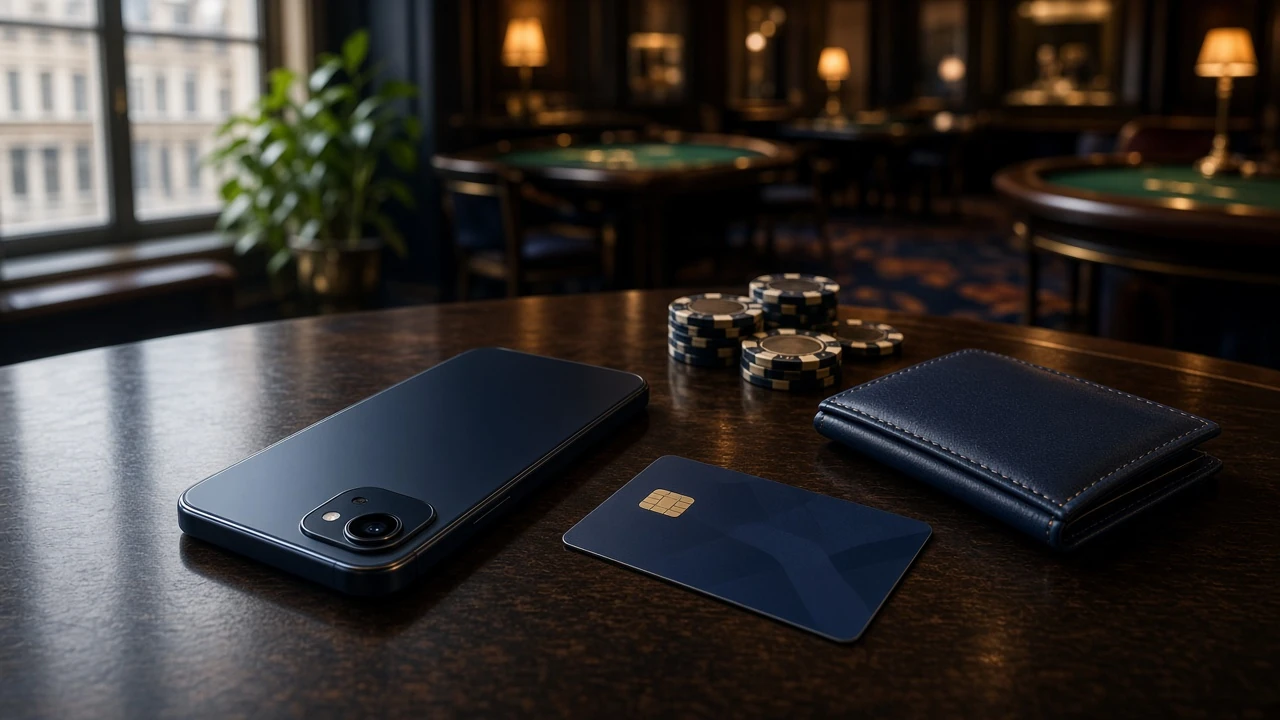
A debit card used through a phone remains an ordinary card deposit. It is not charged to the mobile contract and does not acquire the restrictions associated with phone-bill funding. The distinction is practical as well as technical: the deposit method selected on the cashier determines how the casino records the payment.
Debit-card withdrawals are a separate stage. They typically take one to three business days, even when the original deposit was instant. The screen may be immediate; the banking system is less theatrical.
Paying with PayPal on a mobile casino
PayPal can also be selected from a casino cashier opened on a mobile device. The casino redirects the transaction to PayPal, where the account holder authorises the payment before returning to the gambling account. PayPal deposits are processed instantly at gambling sites, subject to the account being accepted and the transaction completing successfully.
This is still an online payment made from a phone, not a mobile top-up taken from a telephone bill. The distinction becomes especially useful when the casino lists several mobile-friendly methods under one general heading. A mobile interface may contain card, PayPal and bank-payment options together, even though their underlying systems are entirely different.
PayPal also illustrates why depositing and withdrawing should not be treated as mirror images. Withdrawal processing varies by payment method, and e-wallets are generally faster than bank and card methods once the casino has approved the request. The payment account may therefore be convenient for both stages, but the timing and verification requirements still apply.
Verification and Timing
Most casino identity verifications are completed within 24 to 48 hours. Always account for this delay, alongside potential pending withdrawal periods of 24 to 72 hours.
Third-party PayPal accounts must not be used for deposits. The payment account needs to correspond with the casino account holder, because a casino payment is also part of the operator’s identity and anti-fraud controls.
Open Banking from a phone
Open Banking allows a deposit to move directly between the player’s bank and the casino without entering card details. From a phone, the process generally involves choosing the bank-payment option, selecting the relevant bank and authorising the transaction through the bank’s own security process.
Open Banking payments can complete instantly and appear in the gambling account as quickly as a card deposit. This makes the method particularly distinct from a phone-bill payment: the mobile device provides access, but the money is transferred from a bank account.
The absence of card details does not remove the need for account checks. A casino may still require verification before permitting a withdrawal, and most verifications complete within 24 to 48 hours. Payment speed and identity verification are separate clocks. One may finish before the other.
A simple mobile deposit flow
The general process is straightforward:
- Open the UKGC-licensed casino on a mobile browser or app.
- Sign in to the gambling account.
- Select the cashier or deposit area.
- Choose a debit card, PayPal or Open Banking.
- Enter an amount within the displayed limits.
- Authorise the payment through the card issuer, PayPal or bank.
- Check that the balance has updated before starting play.
The minimum deposit is typically £5 to £10, regardless of payment method. The available maximum can differ, with debit-card deposits often reaching £10,000 or more per transaction. The cashier’s displayed terms matter more than a generic label such as “mobile casino top up”.
A mobile device can therefore make a casino deposit feel immediate without changing the legal or financial character of the payment. Card, e-wallet and bank deposits remain distinct routes, each with its own processing and withdrawal behaviour. The useful question is not whether the casino works on a phone. It is which payment system the phone is being used to access.
What Mobile Billing Means for Casino Withdrawals
A mobile-billing deposit creates a one-way movement of money. Pay by Mobile services such as Boku can charge a small casino deposit to the phone bill, but they are deposit-only methods. They cannot receive winnings from the casino. The arrangement is less a full payment account than a narrow entrance: money can go in, but it cannot return through the same channel.
Withdrawal Rule
Note: Mobile-billing is a one-way movement of money. It cannot serve as a destination for your winnings.
That distinction matters when a player chooses to top up casino play or fund slots from a phone bill. The deposit may appear in the gambling account, yet any successful balance must leave by an approved alternative. A phone number is not a withdrawal destination.
Where winnings can be paid
The practical withdrawal route depends on the methods supported by the casino and the account’s verification status.
- PayPal and other e-wallets are among the quickest payout options after account verification. Withdrawals often reach the e-wallet within a few hours, although transferring money from PayPal to a bank can take an additional one to two business days.
- Skrill and Neteller withdrawals often process within 24 hours or faster, subject to the casino’s approval process.
- Debit cards receive withdrawals through Faster Payments. The money typically arrives the same day to a couple of working days after processing.
- Bank transfer is available for larger sums but is generally slower, with withdrawals typically taking two to five business days.
The casino may also apply a pending withdrawal period of 24 to 72 hours before sending funds. Verification comes first: most checks complete within 24 to 48 hours, and UK gambling operators require identity checks before the first withdrawal. A casino that waits until the cashout stage to request basic documents turns a routine payment into an avoidable obstacle.
Paysafecard follows the same principle as Pay by Mobile. It can fund the account, but it is deposit-only; winnings must be directed to another eligible method. The useful question is therefore not merely whether a site accepts a mobile top-up. It is whether the withdrawal route is clear, verified and compatible with the player’s account. That is where convenience stops.
Finding the Best Mobile Top-Up Casino in the UK
This page highlights UK-licensed casino operators for readers exploring mobile top-up options in 2026. Use the listed bonus, payout timeframe and minimum deposit details as a quick starting point when reviewing each option.
License: UKGC Operator Licence · Bonus: £20 bonus · Payout speed: Within 48 hours · Min. deposit: £10 Silverbond Enterprises holds a UKGC Operator Licence and offers a £20 bonus. Its minimum deposit is £10, with payouts stated as being available within 48 hours.
License: UKGC Operator Licence · Bonus: £200 welcome bonus · Payout speed: Within 48 hours · Min. deposit: £10 32Red is a UKGC-licensed operator offering a £200 welcome bonus. It has a £10 minimum deposit and payouts within 48 hours.
License: UKGC Operator Licence · Bonus: £100 bonus · Payout speed: Within 24 hours · Min. deposit: £10 Genesis Global Limited operates under a UKGC Operator Licence and offers a £100 bonus. The minimum deposit is £10, while payouts are stated as being available within 24 hours.
License: UKGC Operator Licence · Bonus: £100 bonus · Payout speed: Within 24 hours · Min. deposit: £10 LeoVegas is UKGC-licensed and offers a £100 bonus. It has a £10 minimum deposit and payouts within 24 hours.
License: UKGC Operator Licence · Bonus: £50 bonus · Payout speed: Within 48 hours · Min. deposit: £10 Platinum Gaming Limited holds a UKGC Operator Licence and offers a £50 bonus. Its minimum deposit is £10, with payouts within 48 hours.
License: UKGC Operator Licence · Bonus: £100 bonus · Payout speed: Within 24 hours · Min. deposit: £10 ProgressPlay Limited is a UKGC-licensed operator offering a £100 bonus. It has a £10 minimum deposit and payouts stated as being available within 24 hours.
The best mobile top-up casino is not necessarily the one with the most polished mobile design. The useful test is whether the payment method sits inside a properly controlled gambling service, with clear limits and a workable route for withdrawals.
A practical checklist
- Check the licence. A UKGC-licensed operator providing online gambling in Great Britain must display a valid UK Gambling Commission licence number. The operator name, licence number and listed domain should match the UKGC public register. A glossy payment page is not a substitute for that check.
- Confirm Pay by mobile acceptance. Boku and similar services are not universal. The casino should state clearly whether Pay by mobile is accepted, rather than leaving the payment icon to do all the talking.
- Read the deposit limits. Mobile billing is intended for small deposits. The relevant minimum and maximum should appear before payment, with no vague suggestion that ordinary card limits apply.
- Look for the cashout route. Pay by mobile is deposit-only. A suitable casino should explain which approved method can receive winnings and how the withdrawal process works.
- Check verification timing. Most verifications complete within 24 to 48 hours. The operator should explain its KYC requirements before the first withdrawal, not introduce identity checks as an unexpected final obstacle.
- Review fees and conditions. Player fees are uncommon at reputable UK sites. Any charge attached to depositing, withdrawing or changing payment methods deserves plain wording.
This produces a more honest definition of “best”: not a fabricated league table, but a casino whose licence, mobile-payment terms, limits, verification and withdrawal arrangements can all be checked before money is deposited. Convenience comes last. Control comes first.
The Best Phone-Bill Casinos in the UK: What the Label Really Means
The phrase “best phone-bill casinos UK” sounds more precise than it is. A casino is not made reliable merely because a deposit can be charged to a mobile account. Pay by mobile, including services such as Boku, is a narrow payment channel: it can support small deposits, but it rarely supports withdrawals. Convenience at the front door says little about the rest of the house.
A meaningful comparison therefore starts with the payment conditions, not with an invented league table of operators. The relevant questions are plain:
- Is the casino UKGC-licensed?
- Is the licence number displayed and matched with the operator and domain in the UK Gambling Commission register?
- Is Pay by mobile clearly marked as deposit-only?
- Are the available withdrawal routes explained before money is deposited?
- Does the account verification process support a straightforward cashout?
The last point matters because the money eventually has to leave by another approved method. PayPal and other e-wallets, along with open banking services such as Trustly, are usually among the quickest payout routes after account verification, often paying within a few hours. That contrast is easy to miss when the promotional focus rests on the instant appeal of a phone-bill deposit.
There is also a social lesson in the label. “Best” often means least friction at the moment of purchase, while a player’s real interest extends to ownership, verification and access to winnings. A payment method can be convenient and still be incomplete.
Deposit ease is not payment quality.
The strongest choice is therefore not a supposed winner of a phone-bill ranking, but a UKGC-licensed casino whose Pay by mobile conditions are explicit and whose alternative cashout route is credible. That is a modest standard, though the industry has often treated modest standards as an unreasonable demand.
What are the best casino payment methods?
Debit cards are the standard choice for instant deposits and broad acceptance. PayPal, Skrill, Neteller and open-banking services such as Trustly are often better for faster withdrawals after verification.
Are there UK casinos that still accept credit cards?
No, UK casino payments cannot be funded by credit card because the restriction has applied since April 2020.
What is the closest equivalent to a credit card at a UK casino?
A debit card is the closest ordinary alternative, allowing instant deposits from an existing bank balance without borrowing. E-wallets and open banking are other available options.
Why did the UK ban credit card gambling?
The ban was intended to prevent gambling with borrowed money and reduce the risk of making wagers while postponing the cost.
What is the fastest withdrawal method at new UK casino sites?
E-wallets such as PayPal, Skrill and Neteller, along with open banking, are generally among the quickest payout methods after verification. Withdrawals may be processed within hours or within 24 hours, depending on the method.
Can you use a credit card at an online casino in Great Britain?
No, online casino deposits in Great Britain cannot be made with a credit card. Debit cards, e-wallets, open banking and other approved funding methods can be used instead.
Prepared by the Casinouk Payments Hub editorial staff.